
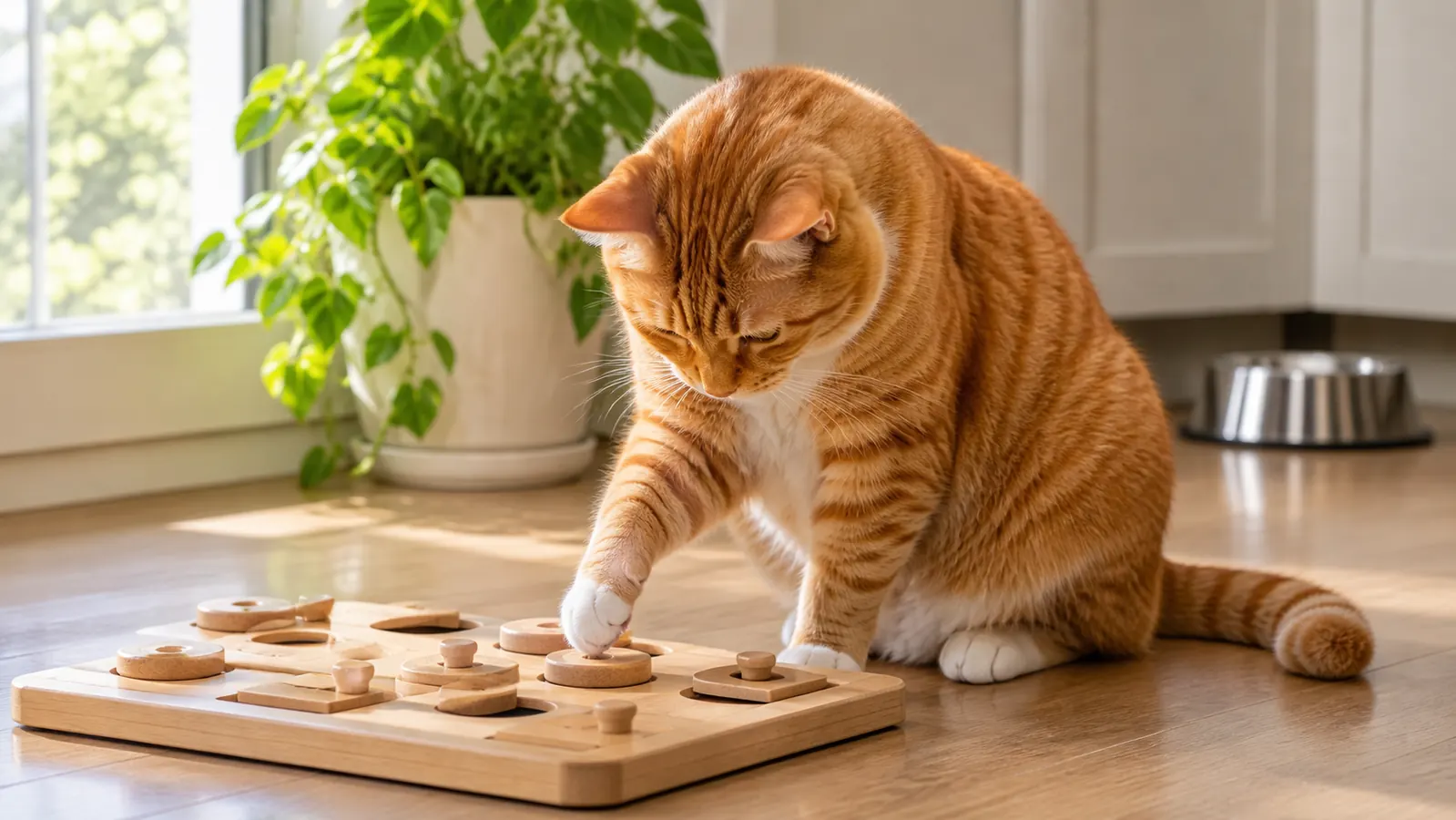
Biscuit is twelve, orange, about fourteen pounds, and convinced that the kitchen is his personal property. He is the reason there is no free-feeding in this house. Every bit of dry food he gets is measured, because at his October 2025 checkup Dr. Patel told me again to help him lose a bit of weight and keep him moving. He is also slow to play. I would dangle a wand toy and he would watch it from a chair like a man reviewing a proposal.
So in January 2026 I ordered the Catstages Nina Ottosson Rainy Day Puzzle and Play, mostly out of a stubborn wish to make him work for something. Ten months later, it lives on the kitchen floor and comes out every afternoon when I get home from the store at two. This is not a review written after a weekend. It is what I saw, what I did not see, and the parts of owning one that nobody mentions.
The Quick Verdict
Slowed Biscuit's afternoon eating and his begging. Holds only about a quarter cup, so it is one tool in a routine, not a whole feeding plan.
Amazon Check Today's Price →If your cat inhales dinner in ninety seconds, this is the board that makes him slow down
Fourteen base compartments plus five treat pegs, adjustable from easy to hard. It is the same one Biscuit has used every afternoon since January.
Amazon Check Today's Price on Amazon →How I've Used It
The routine is the same every day and it matters more than the toy itself. When I get home around two, I scoop part of Biscuit's measured dry food out of his daily portion and put it in the puzzle. Never extra food. The puzzle is a delivery method, not a snack, and if you use it as a snack you will undo whatever your vet is asking you to do.
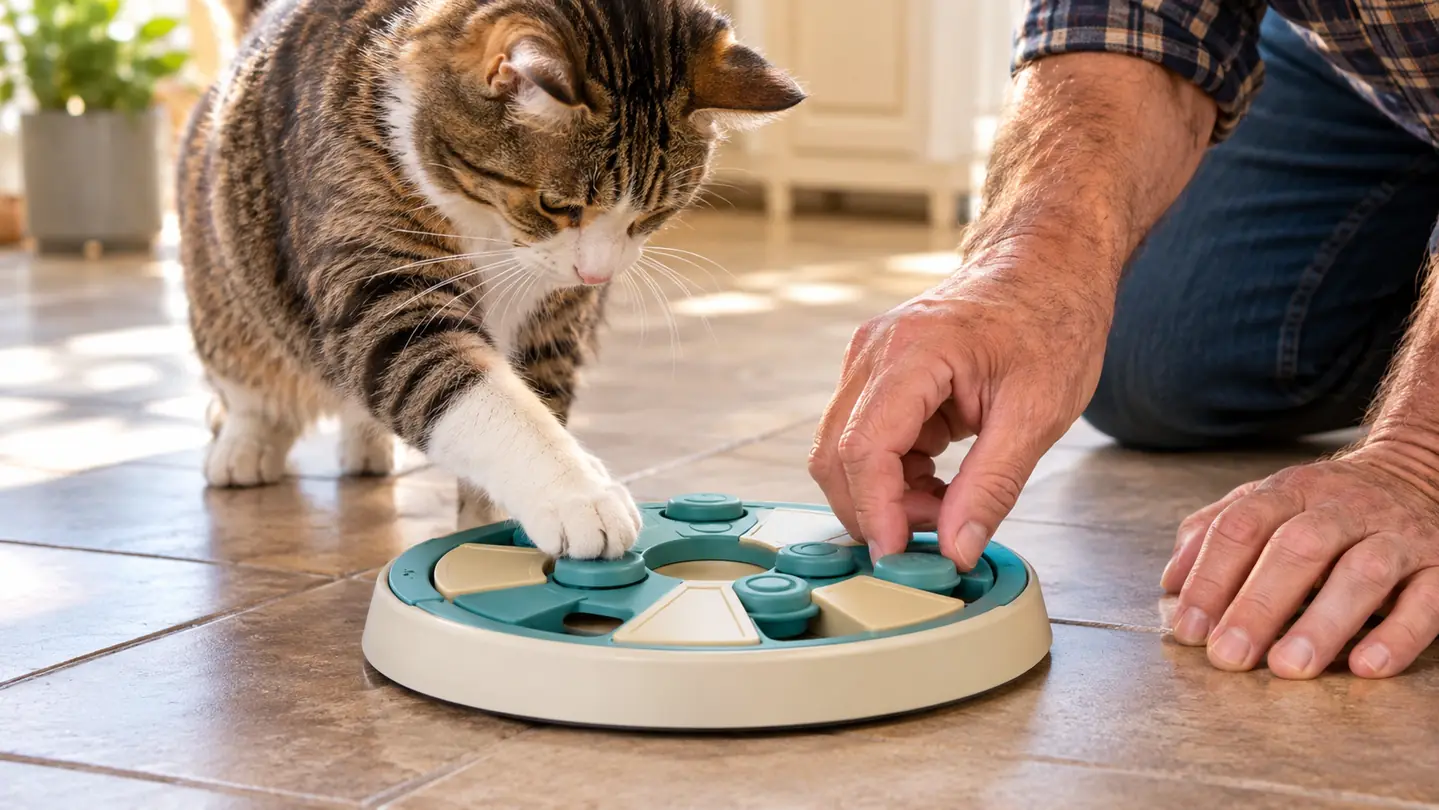
For the first two weeks I used the easier mode the listing describes: treats in the base compartments, a few under the spinning wheel, and the raindrops left uncovered so he could see the food. He circled it, sniffed the edge, and then batted at a raindrop with one paw like it had insulted him. It took maybe four minutes for the first piece to come loose. After that he had it.
Around the end of week three I switched to the harder setting, with the raindrops covering the compartments so nothing is visible. That slowed him down again for a few days. The listing says the board is a Level 3 puzzle, and from where I sit that is fair. It is not a starter puzzle for a cat who has never done one, but it is not a lockbox either.
One afternoon in early February I made a mistake worth repeating. I filled the whole quarter cup in at once with the raindrops uncovered, thinking a fuller board would keep him busy longer. He shoved it against the baseboard with both front paws and cleared most of it in about four minutes. A full board is an easier board. Now I load it about two thirds of the way, spread thin, raindrops down, and he works at it properly for eight to twelve minutes. If you take one thing from this section, take that: less food, higher difficulty, longer meal.
The board itself measures 15.4 by 9.4 by 1.3 inches. I put it on the kitchen scale once out of curiosity and got 1.8 pounds, which is what the listing says. That weight is the reason it stays put. A lighter board would slide across tile every time a paw came down on it, and the plastic slow feeder I tried before this did exactly that. The fourteen compartments are molded into the base in two rows, with the five pegs set along one end and the spinning wheel at the other. Nothing lifts out. Nothing rolls under the stove. After ten months of daily use, the only thing that has changed is a faint dulling on the pegs where his claws hit them.
What the Listing Actually Says, and What It Doesn't
I read the whole product page before I ordered, and I want to be careful about what it promises versus what I saw. The listing calls it a Level 3 puzzle feeder that triggers hunting and foraging instincts. It says it holds a quarter cup of food or treats across fourteen base compartments and five treat-filled pegs. Those numbers match what I see. A measured quarter cup fills it to about the right level, and refilling past that just means kibble spills over the edges.
The listing also says the difficulty is adjustable: easier mode with treats in the base compartments and under the spinning wheel and the raindrops uncovered, harder mode with the raindrops down. That is accurate, and having both settings is the reason this board has stayed in rotation. A fixed-difficulty puzzle would have been solved and abandoned by March.
I checked the ratings before I ordered, because I read reviews the way some people read novels. When I bought it, the listing showed better than four stars across more than thirteen thousand ratings. What I looked for in the bad ones was whether people were complaining that the board broke or that their cat ignored it. Mostly it was the second. That told me the product itself was likely fine and the cat was the variable, which turned out to be exactly right at my house.
It is described as safe and durable with no removable parts. After ten months of daily use and a wash every few days, the pegs still spin and nothing has cracked. The board is not water resistant, so I wash it by hand with a dishcloth rather than soaking it. That was not on the listing as a warning, but it seemed like common sense once I had it in my hands.
What the listing does not say, and what I want to say plainly: it will not make your cat lose weight on its own. It will not fix a cat who is bored with everything. It is a piece of plastic with compartments in it, and how much good it does depends on whether you build a routine around it.
At his October 2026 checkup Dr. Patel said he had lost a little weight. I cannot tell you the puzzle did that, because I also measure everything he eats.
What Changed in the Afternoon
Here is the honest observation, ten months in. Biscuit spends longer working for his food than he used to. What took ninety seconds in a bowl now takes him eight to twelve minutes on the board, and he stays with it. He also begs less in the afternoon. That was the part I did not expect. Before the puzzle he would start yowling by one o'clock, which meant he was ramping up before I even left work.
There is a specific afternoon I keep coming back to. In late March I came home, set the board down, and instead of walking to it he sat down three feet away and looked at me. Then at the board. Then at me again. I have lived with cats my whole adult life and I know a request when I see one. He has done it most afternoons since. I am not going to tell you that means he loves the puzzle. It means he has learned that the board is where the food comes from at two o'clock, and for a food-obsessed cat that is a strong association.
He is more interested in the kitchen floor in general. Some afternoons he walks over to where the board sits and sits next to it, which is about as close as he gets to asking for anything. For a cat who would not chase a wand toy, that is a change.
At his October 2026 checkup, Dr. Patel said he had lost a little weight. I am not going to pretend that was all the puzzle. I measure his food, I stopped free-feeding years ago, and I have been more deliberate about his portions since his weight came up. What I can say is that the puzzle made the measured portion last longer, which made the whole routine easier to keep. Whether that is the toy or just me being more consistent, I genuinely do not know.
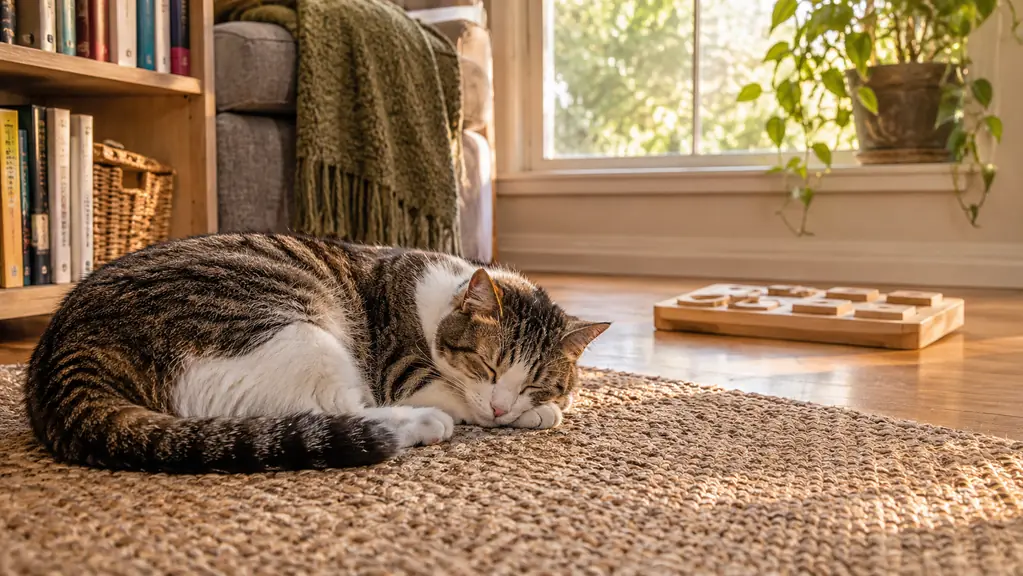
I also want to be clear about what did not change. He still sleeps most of the afternoon. He still asks for wet food at five. He is still a fourteen pound cat who would eat a second dinner if I let him. This is a feeding tool that adds a few minutes of activity, not a fitness program.
The Parts Nobody Warns You About
Junebug is my three year old calico, and she has decided the puzzle is hers. She will muscle in beside Biscuit and knock kibble onto the floor with her paw, then eat it off the tile. So Biscuit now eats in a doorway I can see from the kitchen, and I shoo her off. If you have a younger, faster cat in the house, you will deal with this. It is not a defect in the board, but it is a fact of owning one.
The board needs washing every few days. Cat saliva, crumbs, and the gaps between the pegs add up. Because of the no removable parts design and the not water resistant rating, cleaning means a dishcloth, warm water, and a little patience around the pegs. It takes me about three minutes and I do it at the sink while the kettle heats.
And the quarter cup capacity is real. It is not a whole meal for a fourteen pound cat. It is a portion of one. If you are picturing yourself dumping the day's food in and walking away, this is the wrong product.
Why I Picked This Over Another Bowl
In spring 2025 I had already tried the cheap route. I bought a plastic slow feeder bowl, the kind with ridges in the bottom. Biscuit figured it out inside a week and started pushing it around the kitchen floor like a hockey puck. It went to the donation box. That experience is why I went with a puzzle this time instead of another bowl.
The difference is that a slow feeder bowl is a shape you eat around. The Catstages board is a problem you solve. Fourteen compartments plus five pegs, with a spinning wheel that has to be nudged, is not something Biscuit could brute force in seven days. Ten months in, he still has to work at the harder setting. That is the whole reason it stayed.
I looked at the other styles too, mostly by reading listings at the kitchen table on my lunch break. There are puzzle feeders with removable cups and lids, and I ruled those out because I could picture the cups ending up under the couch within a month. There are ones with moving parts and motors, and I did not want a machine running in my kitchen while I am at work. The Catstages board is one molded piece with pegs and a wheel, and that was the whole appeal. Ten months of daily use later, I would make the same choice.
I looked at the heated beds and the fancy feeders when I was shopping, and I decided against anything with a cord in the kitchen. That is a personal preference, not a knock on anything. What I wanted was something dumb, durable, and washable that made Biscuit use his head for ten minutes a day. This does that.
What I Liked
- Biscuit works for eight to twelve minutes where he used to finish in ninety seconds
- Adjustable difficulty kept it interesting past the first month
- No removable parts, so nothing gets lost and nothing jams
- Broad flat base stays put on a hard kitchen floor
- Holds a measured quarter cup, which makes portioning simple
Where It Falls Short
- Only holds about a quarter cup, so it is not a full meal for a big cat
- Junebug can knock kibble loose and steal it, so feeding needs supervision
- Needs hand washing every few days because it is not water resistant
- A cat already skilled at puzzles may solve the easier mode in one session
- Not a starter puzzle for a cat who has never worked for food
Who This Is For
This is for the owner of a food-obsessed cat who eats too fast, begs between meals, or has been told by their vet to lose a bit of weight. It is for someone willing to measure food and build a small daily routine, and who wants the mealtime to take longer than a minute. It is also good for a cat who is slow to play, because eating is the one kind of play almost every cat will accept.
If your cat already has a puzzle they use and love, this is a reasonable second one because of the two difficulty settings. If your cat is a chaser and a jumper rather than a thinker, a wand toy will get more out of them. Call your vet about any change in eating, drinking, litter box habits, weight, breathing or behavior before you start changing how your cat is fed.
Who Should Skip It
Skip it if you are looking for a whole-meal feeder, because a quarter cup will not cover it. Skip it if you have a young, dominant cat who will simply take the food from a slower one, unless you are willing to feed them in separate rooms. Skip it if you want something you can rinse and leave in the sink, because this needs a hand wash and a dry. And skip it if you are not already measuring your cat's food, because a puzzle feeder on top of free-feeding is just a toy.
One more thing I would tell anyone. The puzzle did not make Biscuit a different cat. He is still twelve, still orange, still about fourteen pounds, still convinced the kitchen is his. What it did was give him ten minutes of thinking at two in the afternoon instead of ten minutes of yowling. For the money and the counter space, at my house that has been a fair trade.
Ten months in, the board is still on my kitchen floor
Fourteen compartments, five pegs, two difficulty settings, no removable parts. If your cat eats like the bowl owes him money, start here.
Amazon Check Today's Price on Amazon →