
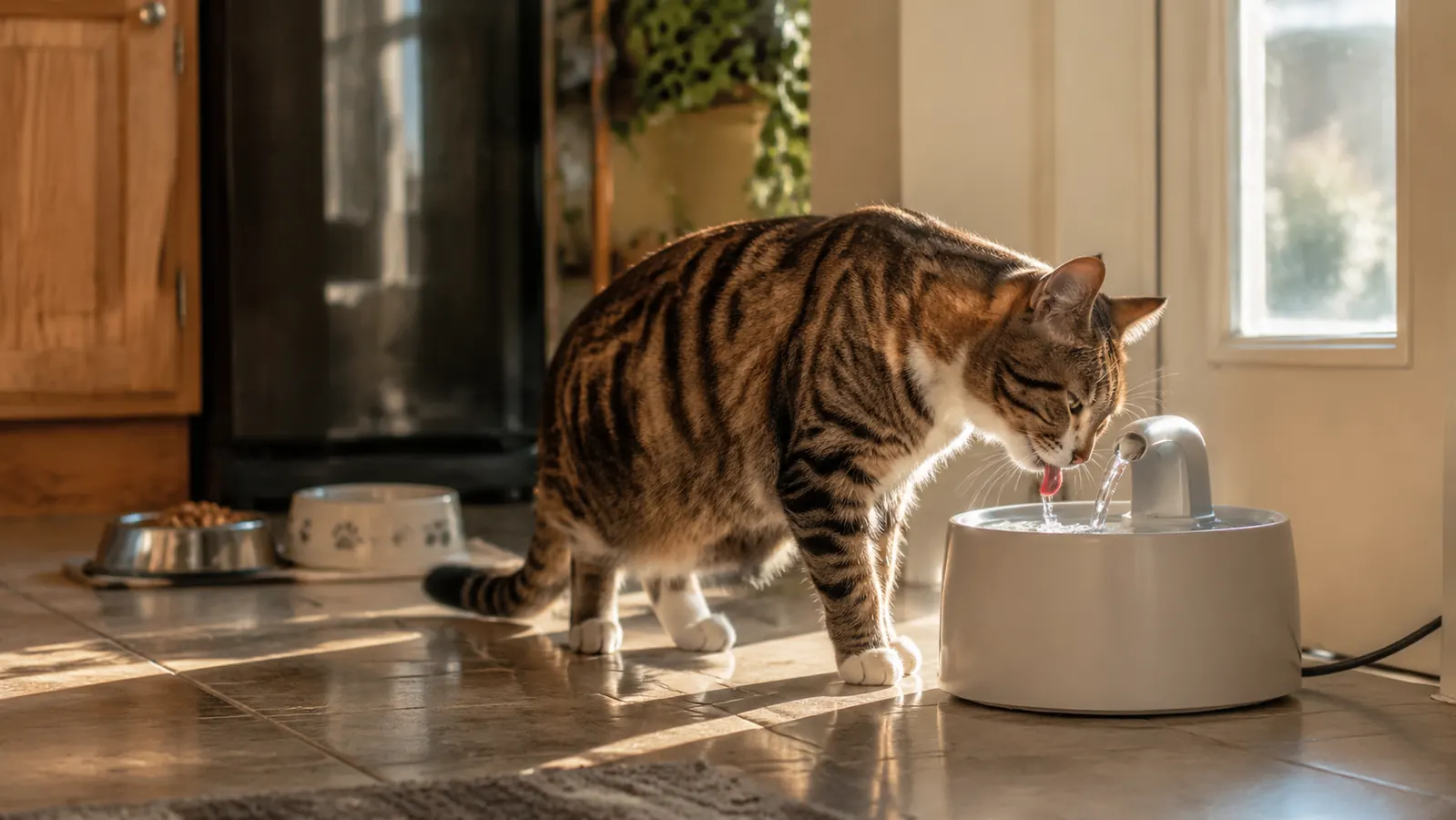
Pepper is nine years old, black, about nine pounds, and she has never been much of a drinker. For years I kept one plain white ceramic bowl on the kitchen floor and she walked past it the way you walk past a piece of furniture. At her February 2025 checkup, Dr. Patel suggested I look for ways to encourage her to drink more. No diagnosis, no alarm, just a sensible suggestion from a vet who has known this cat her whole life. I thought about it for a week, then ordered the Veken C1 Classic fountain in March 2025. That was twenty months ago. This is the plain account of what I did with it and what changed at my house.
What I am not going to do is tell you that a fountain solves anything. I am not a vet, and I have no way to measure how much water goes into a cat. What I can tell you is what I watched happen in my own kitchen with my own four cats, and what the listing says about how the thing is built. If you want the long background on twenty months of ownership, I have a separate write-up on that. This piece is the practical part: five steps, in the order I did them, that got Pepper drinking from a fountain instead of walking past a bowl.
The Bowl Pepper Finally Walked Over To
The Veken C1 Classic holds 95 ounces, runs two flow modes, and has a water-level window so you can see at a glance when it needs a refill. It is the one I have had plugged in since March 2025.
Amazon Check Today's Price on Amazon →Why a Fountain Got My Attention at All
The argument for a fountain is simple enough. Moving water catches a cat's attention in a way a bowl of still water does not. I do not know whether that is instinct or curiosity, and I am not going to pretend I do. What I know is that Pepper investigated the fountain the first afternoon it was running, which is one more investigation than the ceramic bowl got in nine years.
There was a second reason, and it is a boring one. I leave for work at 4:40 in the morning and I am home around two. A bowl of water sits there all day getting warm and collecting hair. The Veken circulates the water through a five stage filtration system, and the listing says to clean the pump and replace the filter every one to two weeks. That is more work than a bowl, and I want to say so up front, because it is the part people leave out.
Step 1: Put It Where Your Cat Already Walks
My first mistake with the ceramic bowl was location. It sat in a corner between the counter and the wall, which was convenient for me and apparently uninteresting to the cats. When the fountain arrived I put it on the kitchen floor by the back door, about six feet from the food bowls. Pepper crosses that spot several times a day on her way to the screened porch.
Six feet turned out to be about right. Close enough that she sees it while she is thinking about food, far enough that she is not drinking where she eats. Some cats are fussy about that. Pepper is fussy about most things.
I also took the ceramic bowl out of the rotation for a while. Two water sources side by side would have told me nothing, because I could not have said which one she was using. One source at a time, at least at the start, and then compare notes with yourself after a couple of weeks.
One practical thing before you pick a spot. The Veken is corded, and the pump comes with a six foot power cord. You need an outlet within reach and you need the cord out of the traffic path. Mine runs along the baseboard to the outlet by the door, with the slack tucked behind the trim. Junebug, my three year old, will bat at anything that dangles.
Step 2: Pick One Flow Mode and Leave It Alone
The fountain has two flow designs. One is the flower waterfall, where water spills over the top the way a faucet runs. The other is the gentle fountain, where it bubbles up more quietly. I used the flower waterfall for the first week because it seemed more interesting to me. Pepper drank from it, but the sound of falling water carried into the living room and I got tired of it.
So I switched to the gentle fountain and left it alone. That was March 2025 and it has not moved since. If your cat ignores one mode for a few days, try the other, then stop fiddling. The mode you find pleasant is not necessarily the mode your cat prefers, and the only way to learn that is to watch her.
One more thing about sound, because I wish someone had told me. The pump has a faint hum at night. It is not loud, and I stopped hearing it after about two weeks, but my bedroom is at the other end of a small house and the kitchen is not. Gary noticed it before I did. If you sleep near the kitchen, listen to it running before you decide where the fountain lives.
There is a switch on the cord, which I use more than I expected. When I am cleaning the basin I flip it off instead of crawling under the cabinet for the plug. Small thing. I notice it every second Sunday.
Step 3: Fill It Up and Learn to Read the Window
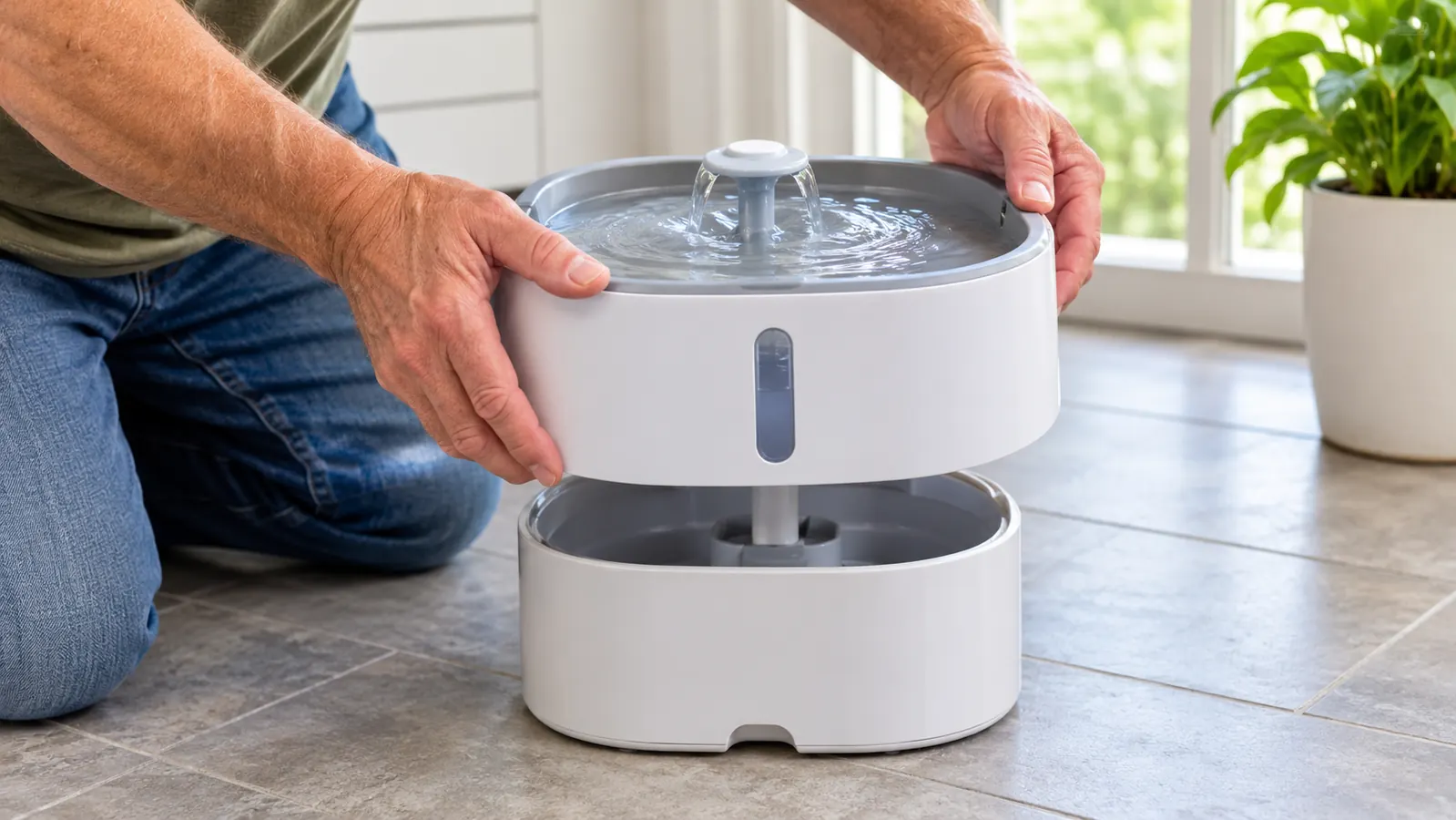
The Veken C1 Classic holds 95 ounces, about 2.8 liters. It measures 8.4 by 8.4 by 5.3 inches and weighs 1.9 pounds empty, so it does not eat much floor. I refill mine every other day rather than topping it off daily, because a full basin is easier to carry than a half full one.
The feature I use most is the water-level window. I can see from across the kitchen whether it needs a refill without picking it up. There is also a blue LED light that makes the water easy to find in a dim room. The first night it looked strange glowing on the floor. I got used to it in a week, and the cats never seemed to care either way.
Watch the level more carefully in the first few days than you think you need to. A fountain that runs dry is a pump that will not run again. If you are gone for a weekend, this is not a product you can leave alone unless someone is checking on it.
I also fill it over the sink and carry it back, rather than pouring from a pitcher while it sits on the floor. Water ends up on the linoleum either way, but there is a lot less of it this way.
Step 4: Take the Pump Apart Before It Tells You To
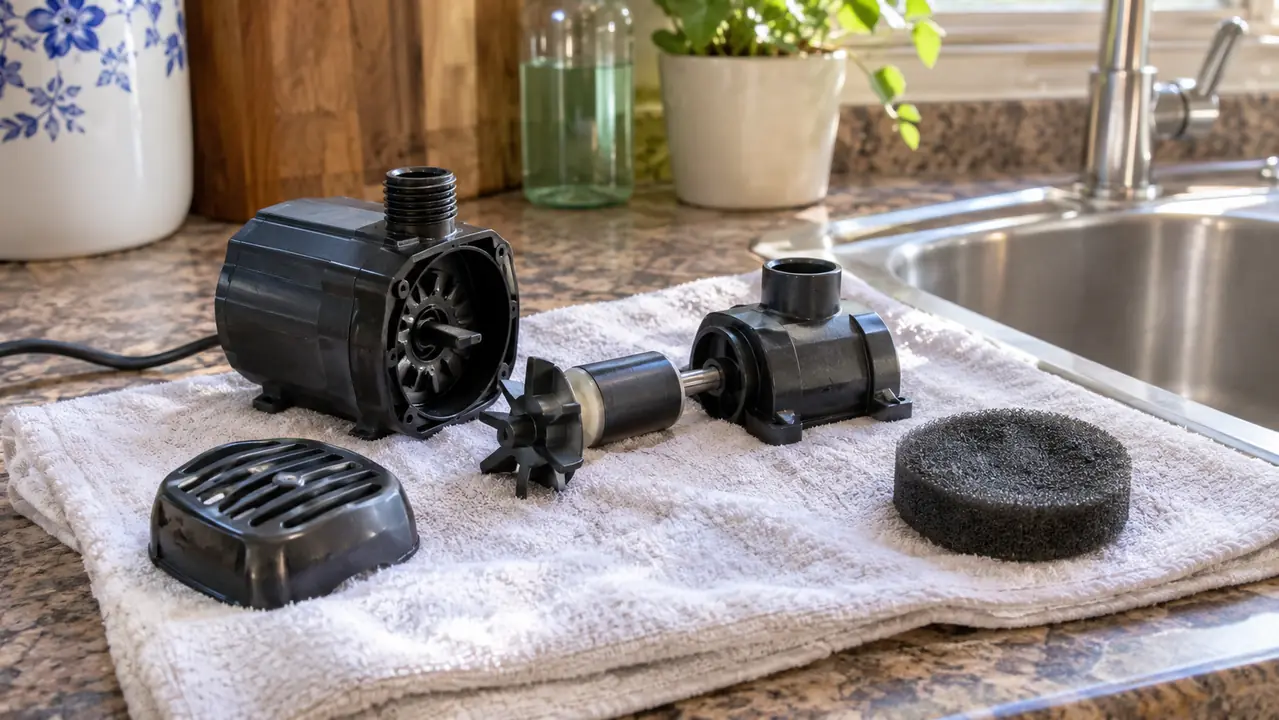
This is the part that separates people who keep a fountain for years from people who throw one away in the spring. The listing says to clean the pump and replace the filter every one to two weeks. I do mine every second Sunday afternoon. It is not hard. It is a chore, and if you skip it the flow weakens and then you decide the fountain is broken.
My routine: flip the switch, lift the top off, take the pump apart, rinse the impeller area, wipe the basin, put it back together with a fresh filter. Fifteen minutes if I am organized, twenty five if I am not. I do it on the screened porch when the weather is decent, which keeps the kitchen from looking like a small appliance exploded.
I keep a spare filter in the plastic bin with the rest of the cat supplies so I am never doing the Sunday job without one. That was the one change that made the routine stick.
The five stage filtration system keeps the water fresh between cleanings. It cannot clean the pump for you. If you know going in that this is a twice a month job, you will be fine. If you want something you can fill and forget, a plain bowl is the better choice, and I still keep mine in the cabinet.
Step 5: Give It Weeks, Not Days
The first week I watched Pepper like she was a science project. She sniffed the fountain, drank once, walked away, and I decided it had failed. Then in the second week she started stopping at it on her way past. By the end of the month she was drinking from it several times a day. That is the honest timeline at my house. Not overnight.
I cannot tell you how many ounces she drinks. I have no way to measure it and I am not going to guess. I can tell you that I refill the basin more often than I used to fill the bowl, and that Biscuit, my twelve year old orange tabby, drinks from it too, which I did not plan for. Two cats on one fountain means more refills and more cleaning.
Keep a bowl out anyway. I did for the first month, in a different room, and I still keep one in the hall bathroom. If your cat never takes to the fountain, you have lost nothing but a little floor space. If she does, you have two water sources instead of one, which is not a bad thing in a house with four cats.
What Else Helps
Water intake is not only about the bowl. Dr. Patel's suggestion was to encourage Pepper to drink more, and the fountain was one part of that. The other part was food. My cats get wet food twice a day, each at her own spot in the kitchen, and a good share of their water comes from that. If your cat is on dry food only, that is a conversation for your vet, not for me.
Multiple water stations help too. I have the fountain in the kitchen and a plain bowl in the hall bathroom, and I empty and refill that bowl daily. Cats are territorial and lazy in equal measure. A cat who will not walk to the kitchen will often drink from something three feet away in a room she already likes.
And keep the water away from the litter boxes. That is the one piece of cat advice I will state flatly. Nobody wants to drink where they do their business, and I have never met a cat who disagreed. My three boxes are in the laundry room, the spare bedroom and the hall bathroom, and the fountain is not near any of them.
The last thing I stopped doing was moving the fountain around looking for a better spot. Cats build a routine around a place, and every time I shifted it, Pepper had to start over. The kitchen floor by the back door is where it lives now, and it is where it will stay.
I cannot tell you how many ounces Pepper drinks in a day. I can tell you she walks over to the fountain four or five times, which is four or five more times than she ever walked to the bowl.
When to Call Your Vet Instead of Buying Anything
A fountain is a nice thing to have. It is not a substitute for a vet. If you are reading this because your cat's drinking has changed, call the clinic. A cat who suddenly drinks much more or much less, stops eating, starts using the litter box differently, loses weight, or breathes differently needs a person with a stethoscope, not a product recommendation. Pepper's checkup is every February and I bring it up every year.
For what it is worth, I am a fifty six year old assistant manager at a gas station convenience store in Hickory. I am not a vet tech, not a groomer, and not an expert on anything except my own four cats. Everything above is what I saw on my own floor between March 2025 and now. Your cat is not my cat, and that is the whole point.
Twenty Months In, It Is Still Plugged In
The Veken C1 Classic is plastic, holds 95 ounces, and carries a two year warranty. Mine has run almost every day since March 2025, and the only thing it has ever needed is a refill and a clean pump.
Amazon Check Today's Price on Amazon →