
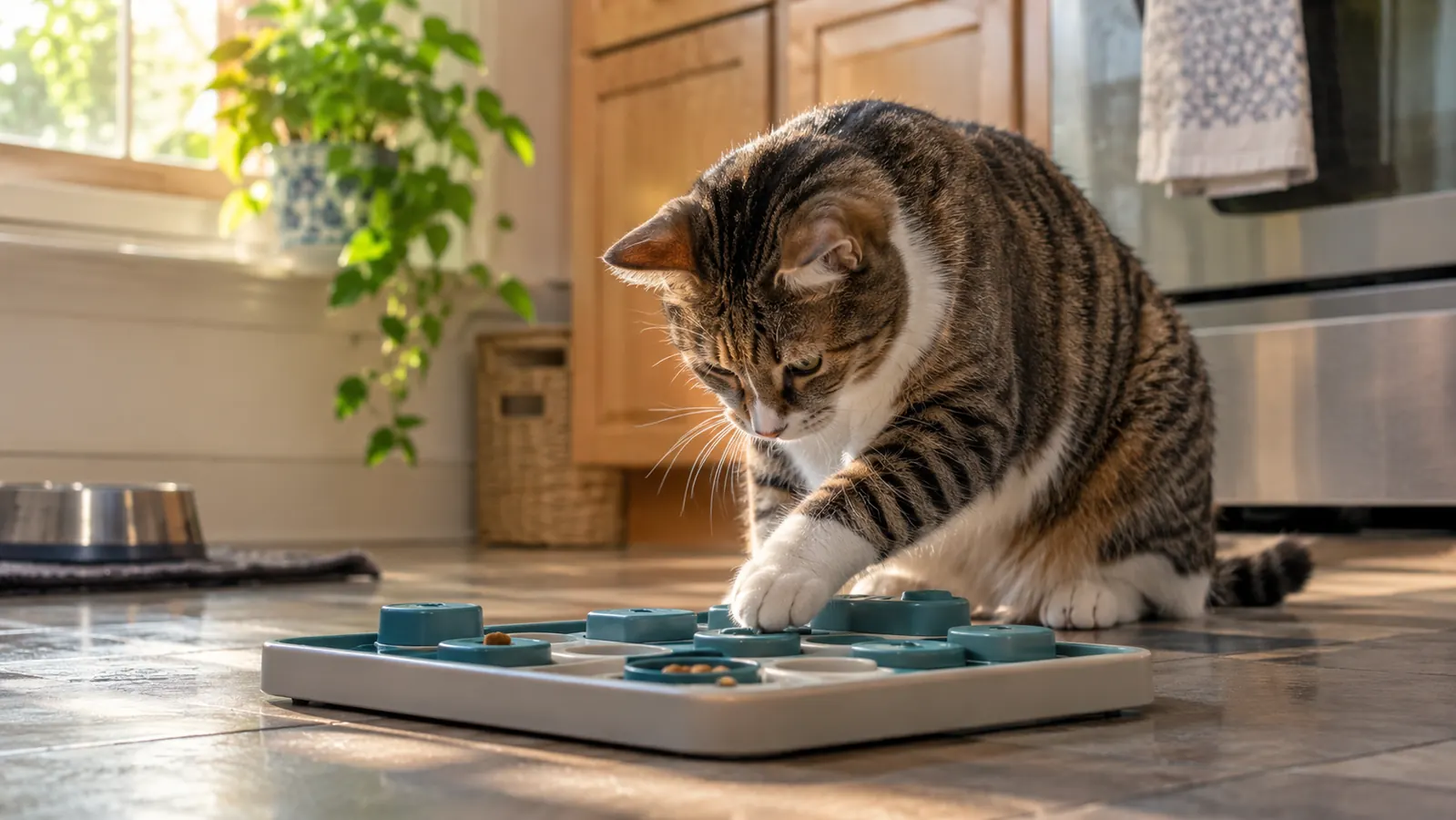
Biscuit is twelve years old, orange, about fourteen pounds, and he thinks about food more than he thinks about anything else. He starts yowling around 3:30 in the afternoon, an hour and a half before his wet food goes down, and he yowls with his whole body. I have fed him measured dry food and wet food on a schedule for years. That schedule did not stop the yowling. What has helped, at least partly, is giving him a problem to solve instead of a bowl to inhale. The problem is a Catstages puzzle, and I want to be plain about how I got there.
I work the early shift at a convenience store here in Hickory, so I am up at 4:15 and home around two in the afternoon. For years Biscuit's afternoon went like this: I walk in, he yells, I put the bowl down, and it is empty before I get my shoes off. That is not a cat enjoying his food. That is a cat who barely tastes it. Dr. Patel has seen him every October since he was a kitten, and at his October 2025 checkup she told me again to help him lose a bit of weight and keep him moving.
The first thing I bought, back in spring 2025, was a plain plastic slow feeder bowl. He beat it in under a week. He nosed it around the kitchen floor until the kibble slid out the sides, then sat and looked at me like I had insulted him. It went to the donation box. In January 2026 I ordered the Catstages Nina Ottosson Rainy Day Puzzle and Play instead. It is a flat puzzle, about fourteen inches across, with fourteen compartments in the base, five pegs and a spinning wheel. There is nothing on it to flip over.
A cat who eats in ninety seconds does not need a bigger bowl. He needs a harder problem.
The Catstages Rainy Day puzzle holds a quarter cup of his measured kibble across fourteen compartments and five pegs, with two difficulty settings. Start with the raindrops uncovered and let him win a few times.
Amazon Check Today's Price on Amazon →How I Set It Up, Step by Step
Step 1: Talk to Your Vet Before You Change Anything
A cat who is suddenly frantic about food is not automatically a cat who needs a puzzle. A cat who is eating more than usual, or losing weight while still eating, or has stopped eating, needs a vet, not a toy. I am not a veterinarian and I do not play one on the internet. I am a woman with four cats and a job, and I have learned the hard way that behavior changes are worth a phone call before they are worth a shopping trip.
Biscuit's situation was different. He was already a little heavy, Dr. Patel had told me at his October 2025 checkup to help him lose a bit of weight, and the rest of that visit was uneventful. Nothing was wrong with him. He was a bored, food-obsessed cat who ate faster than his body could register. Dr. Patel did not suggest a puzzle. That part was mine. She said help him lose a little weight and keep him moving, and I went home and thought about how to do that without him screaming at me all afternoon.
Step 2: Take the Food Out of His Bowl, Not Out of His Day
The single rule that makes this work is that the puzzle does not get extra food. It gets part of what he was already getting. Biscuit's dry portion is measured, twice a day, and I take a quarter cup of his afternoon portion and put that into the puzzle instead of the bowl. A quarter cup is all the puzzle holds, so it is not a meal on its own. He gets the rest of his dry food in his bowl and his wet food exactly as usual.
I will be honest, the first week I was tempted to top it up. He looked so put out. But adding food would have made the whole exercise pointless, and with a cat who is already a little heavy it would have been worse than pointless. The puzzle is not a treat dispenser. It is a slower way to deliver the same dinner he was getting before.
If you are going to try this, measure what your cat actually gets in a day and take the puzzle portion out of that number. It sounds fussy. It takes one extra minute at the counter. And if your cat is on a specific diet for any reason, call your vet before you start moving food around, because the puzzle changes how fast he eats, not what he eats, and even that is worth a conversation.
Step 3: Start in Easier Mode and Let Him Win
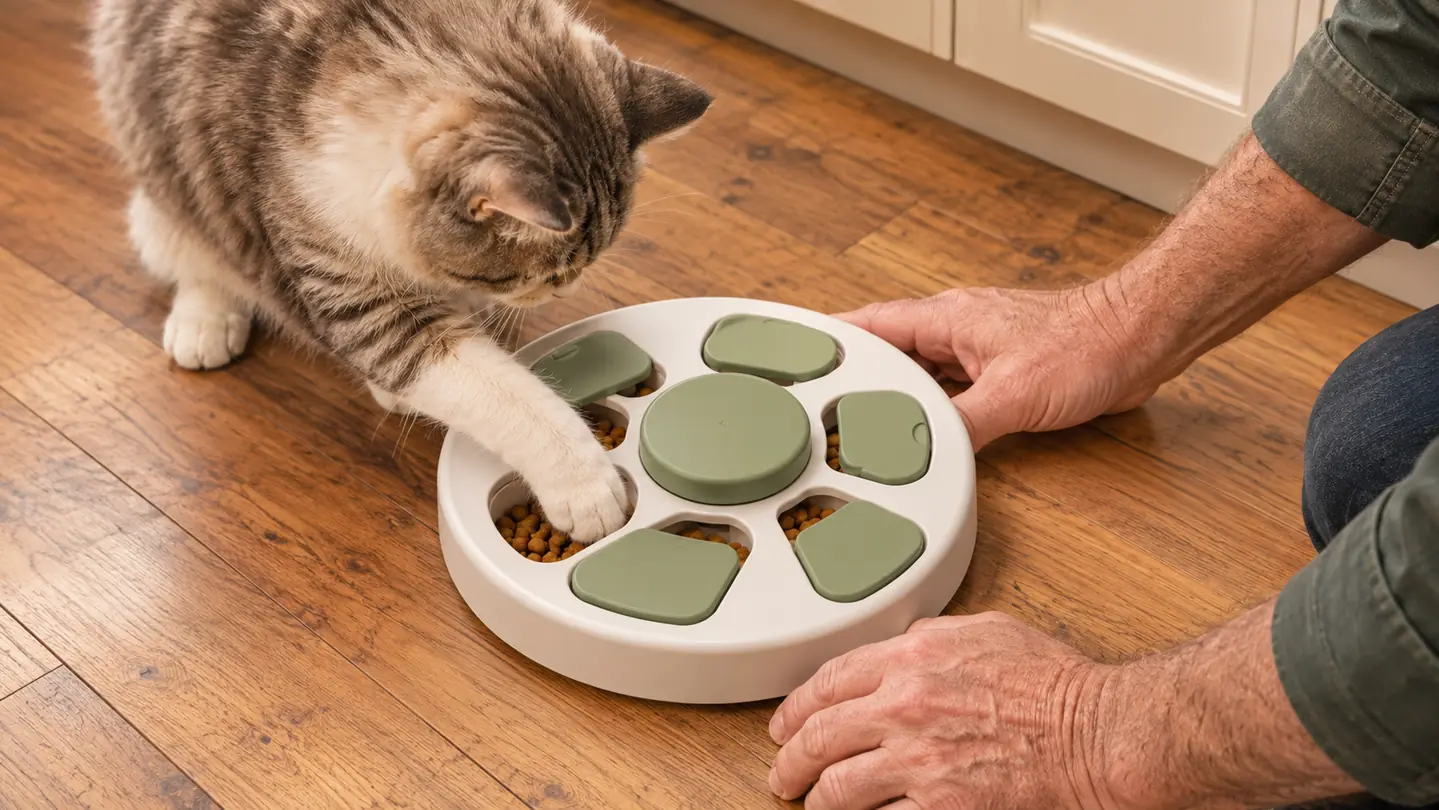
The Catstages puzzle has two settings. In the easier one you put food in the base compartments and under the spinning wheel and leave the raindrops uncovered, so he can see the kibble and get a paw to it. In the harder one the raindrops go down over the compartments and he has to work out how to move them. I left it in easier mode for the first two weeks. He needed to learn that the thing on the floor was food and not a hazard.
Do not skip this. I nearly did, because he is a smart cat and I assumed he would figure it out. He did figure it out, in about three days, and then he sat beside it and waited for me to make it easier. Cats are not above asking for help. Two weeks in easier mode built the habit of going to the puzzle when it hits the floor, and that habit is what everything else rests on.
He works at it for ten or fifteen minutes now instead of eating in under a minute. At his October 2026 checkup Dr. Patel said he had lost a little weight. I cannot credit the puzzle alone, because I also measure his food.
Step 4: Make It Harder Once He Is Fast
Once he was clearing the easier setting in a couple of minutes, I covered the raindrops and moved him to harder mode. That slowed him down again. Watching him work out that the raindrops move is the closest I have come to seeing a cat think out loud. He uses one paw, then the other, then his nose.
The listing calls this a Level 3 puzzle, and Level 3 is about right for a cat who has already beaten a slow feeder bowl. If your cat has never used a puzzle at all, the easier setting is still where you begin. The adjustable difficulty is the main reason I picked this one over the other shapes in the same line, because it means the thing can grow with him instead of joining the bowl in the donation box.
The other reason to go slowly is that a puzzle which is too hard is a puzzle that gets ignored. Biscuit walked away from a covered raindrop the first afternoon and went and sat by his bowl. I uncovered two of them, he came back, and after a few days all five were down. Build the difficulty. Do not dump it on him.
Step 5: Put It Down at the Same Time Every Day
The puzzle goes on the kitchen floor at about two o'clock, when I get home. Same spot, same time, same part of his food. Cats run on routine and the routine is doing half the work here. Now he waits by the kitchen door in the afternoon instead of yowling at the living room ceiling. That is a small thing, and it has made my afternoons noticeably quieter.
Cleaning matters more than I expected. There are no removable parts, so it does not come apart to wash, and it is not the sort of thing you want to leave sitting with old food in the crevices. I rinse it in the sink with warm water and a little dish soap every few days and set it on the rack to air dry. It weighs under two pounds, so I can pick it up one-handed, which matters when there is a cat underfoot telling me to hurry.
I keep the puzzle in one spot and I do not move it around the house. He knows where it lives. When the weather is warm I take it out to the screened porch and he works at it out there, but that is the only variation. Every other day of the week it is the same puzzle in the same place, and that sameness is doing more than I gave it credit for.
What the Listing Says and What I Saw
The Catstages listing says the puzzle holds a quarter cup of food across fourteen base compartments plus five treat-filled pegs, and that matches what I see at home. A quarter cup is a snack, not a meal. It measures about fifteen and a half inches by nine and a half and stands a little over an inch tall, and it does not slide around much on my kitchen floor. It is not water resistant, which is why I dry it on the rack rather than leave it wet in the sink.
What I saw: he spends longer working for his food in the afternoon and he begs less. The 3:30 yowling has mostly moved to a general interest in the kitchen around four, which I can live with. His weight went the right direction at his October 2026 checkup. I cannot say the puzzle alone did that, because I also measure his dry food and always have. Anybody who tells you one toy did it is selling something.
The downsides, plainly. Junebug, who is three and nervous and built like a small cannon, sometimes muscles in and knocks kibble onto the floor, so I sit with them while the puzzle is down. It needs washing every few days or it gets greasy. And it holds a quarter cup, so if your cat eats a large portion in one sitting this will not hold all of it. You can split the puzzle into two sessions. That is what I do on the days he is especially loud.
One Thing I Would Have Done Differently
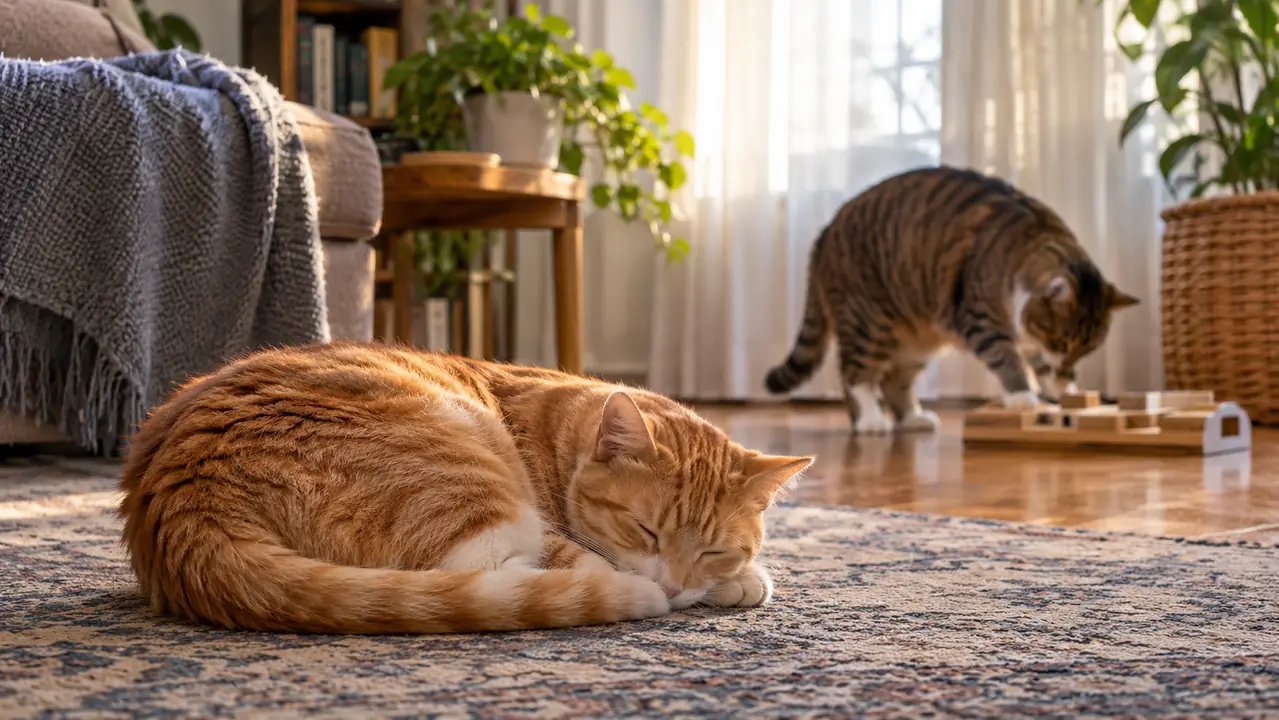
I would have started him on the puzzle a year earlier. I spent most of 2025 trying containers of different shapes, and every one of them was a bowl with a complication rather than a problem to solve. The Catstages puzzle takes about two minutes of my afternoon and it replaced a slow feeder bowl he had beaten inside a week. That is a year of afternoons I could have spent with a quieter kitchen.
The other thing I would do differently is simpler. I would sit with him for the first week instead of putting the puzzle down and walking away. I missed two or three days early on where he stopped partway through and left kibble sitting in the compartments, because he had taken what he wanted from the easy ones and lost interest. Watching him told me when to make it harder. That is the whole method: watch, adjust, keep the portions honest.
What Else Helps
The puzzle is one part of it. The other parts are less interesting, which is usually how it goes. I kept his wet food exactly as it was, twice a day, because I did not want to change three things at once and then not know which one mattered.
I also had a word with my husband. Gary is home all day, he pretends not to like the cats, and he feeds them treats when I am at work. I am not going to pretend that stopped overnight. It did stop being a handful of treats four times a day once I pointed out that Biscuit was supposed to be losing a little weight, not holding steady through sheer goodwill from a retired man with a soft spot.
And I play with him. Ten minutes with a wand toy before the puzzle goes down is not a big ask and does more for his afternoon than another bowl ever did. If your cat is a bolter rather than a picker, the idea is the same: get the food out of the bowl and onto something he has to work at. It is not complicated. It just takes a cat who is willing and a person who is consistent. If your cat's eating, drinking, litter box habits, weight or behavior change at any point, call your vet.
A slow feeder bowl buys you a week. A puzzle with two settings buys you a habit.
The Catstages Rainy Day puzzle holds a quarter cup across fourteen compartments and five pegs. Start with the raindrops uncovered, then cover them once he is quick. Always use part of his measured food, never extra.
Amazon Check Today's Price on Amazon →