
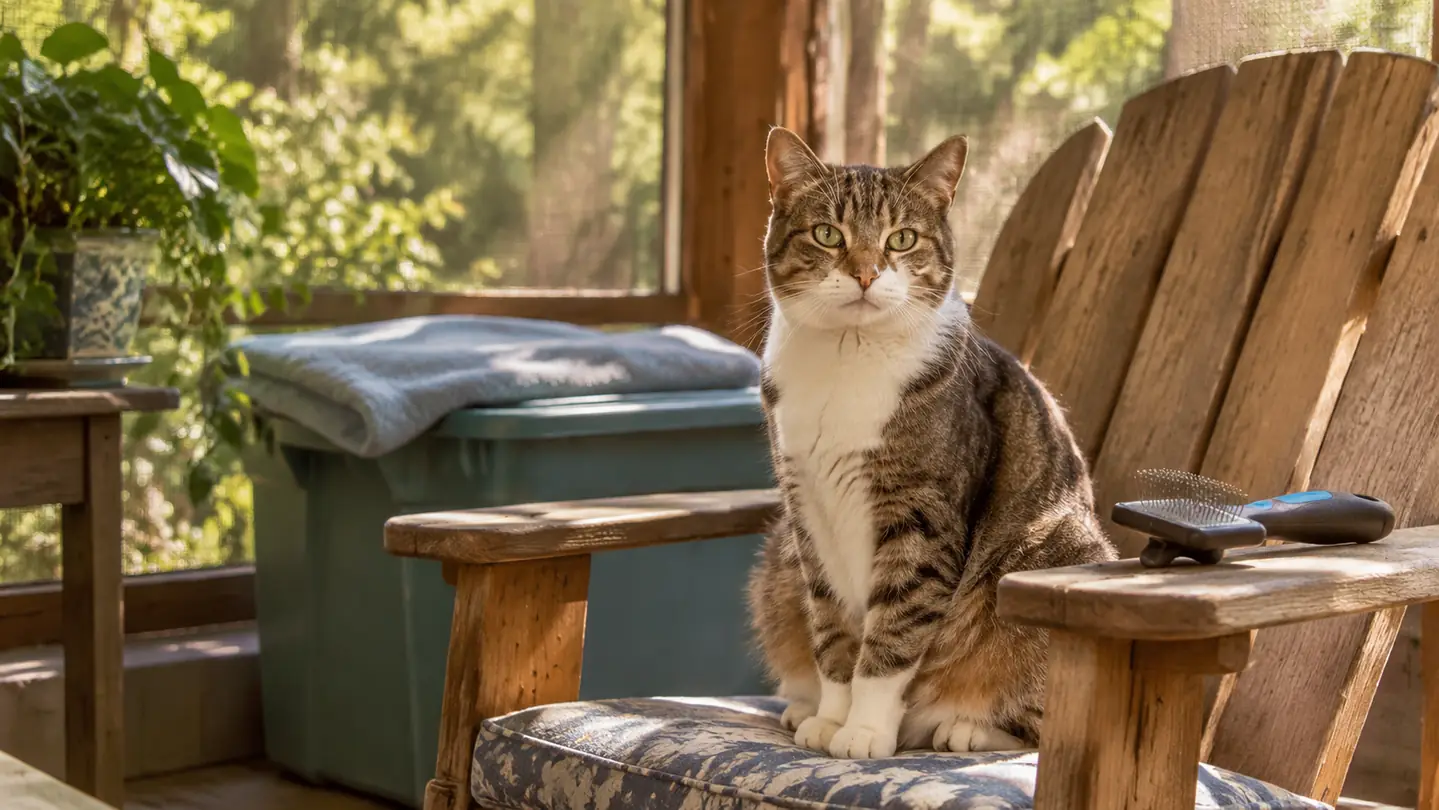
I bought the FURminator deShedding tool for medium to large short-haired cats in June 2025 because I was finding calico hair in my coffee cup, on my husband Gary's work shirts, and across the one couch cushion I actually like to sit on. Junebug is our youngest, a three-year-old calico we adopted from the shelter in spring 2024, and her first full summer in this house taught me what shedding really means. I am not a groomer and I am not a vet tech. I am fifty-six, I work the early shift at a convenience store in Hickory, North Carolina, and I brush cats on a screened porch in the afternoon because that is when I am home. This is what seventeen months with one tool has looked like, including the parts the product page leaves out.
The short version: it works better than the grocery store slicker brush I had been using, and I still reach for it two or three afternoons a week. It is also the easiest cat tool I own to overdo, and I overdid it in the first month. That part is worth more of your attention than the star rating.
The Quick Verdict
Pulls far more loose hair than a slicker brush on a short coat, but it rewards a light hand and punishes rushing. It is not for thin-coated seniors, and it does not make a cat shed less.
Amazon Check Today's Price →The tool that finally got ahead of my youngest cat's summer coat
Seventeen months in, this is still the first thing I pick up on the porch. Light strokes, five to ten minutes, with the hair. That is the whole method.
Amazon Check Today's Price on Amazon →Why I Bought It, and What I Was Using Before
Before June 2025 I had exactly one brush: a slicker I picked up at the grocery store years ago, the kind with fine wire pins on a padded rectangle. It moved hair around. It did not remove much of it. I would finish brushing Junebug, watch her walk away, and find a fresh layer of hair on the cushion ten minutes later. Gary had started keeping a lint roller in his truck, which tells you how bad it had gotten and also tells you what my husband thinks counts as a solution.
What pushed me to spend my own money was not one dramatic moment. It was a Tuesday. I had brushed her for ten minutes with the slicker, put the brush down, and she shook once and left a cloud of hair hanging in the air over the kitchen floor. I got on Amazon that afternoon and read through the FURminator listing the way I read the back of a feed bag, slowly, twice. The medium to large size for short hair was the one that matched her: about ten pounds, short coat, no mats anywhere.
What the Listing Says, and What It Actually Did
The listing makes three claims that mattered to me. It says the stainless steel deShedding edge reaches through the topcoat to remove loose hair and undercoat without damaging the coat. It says the edge is curved so it glides over the skin instead of digging in at the corners. And it says to choose the large size for cats over ten pounds, which is why I did not order the small one even though Junebug is a smallish cat by build.
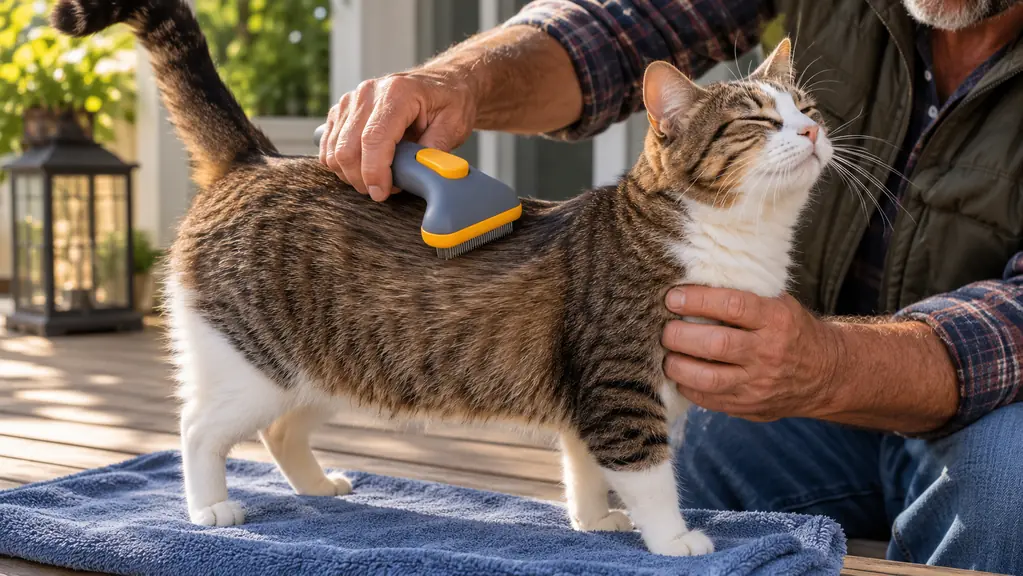
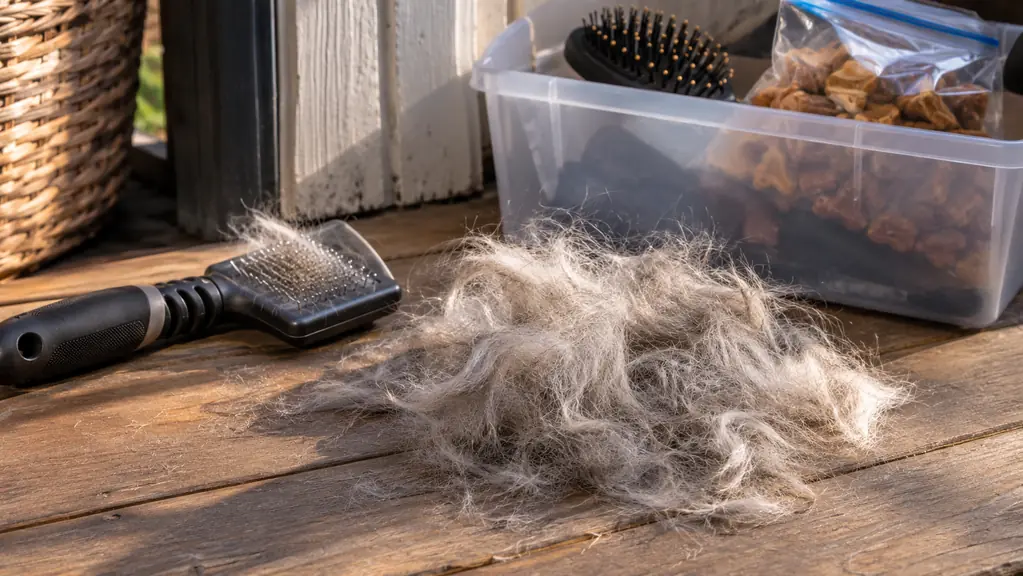
Here is what that looked like in my hand. The first session, on the porch, maybe four minutes in, I had a mat of loose hair on the tool bigger than anything the slicker ever collected in a month of Sundays. That is the whole argument for the tool, and I am not dressing it up. The curved edge does what the listing says: it sits against the body and follows the back instead of catching at the shoulder blades. Junebug, who twitches the second a brush pulls, stayed put for the first three minutes.
The tool itself is light. The listing puts it at 5.44 ounces and about 8.75 inches long, and that feels right in the hand, though the grip is a plain plastic and rubber handle, nothing cushioned. There is no button, no blade guard, no adjustment of any kind. It is a handle with an edge on the end. That is worth knowing before you order, because a few of the reviews I read seemed to expect more machinery than that and came away disappointed.
How It Compares to the Slicker I Already Own
I still have the slicker. It lives in the laundry room bin next to the FURminator and it comes out most weeks, just not for Junebug. The difference between the two is where they sit in the coat. A slicker's pins skim the surface and pick up whatever is already loose on top. The deShedding edge gets underneath and pulls what was on its way out anyway. That is why the pile looks so much bigger. It is not tearing out healthy hair. It is collecting what your couch would have collected by Thursday.
The tradeoff is forgiveness. I can brush Mabel with the slicker for ten minutes and nothing bad happens. I cannot do that with the deShedding edge on a cat with a thin coat. It is the more effective tool and the less forgiving one, and both of those things are true at the same time. If you already own a slicker, keep it. You will want it for the cats who do not need the heavier tool, and you will want it on the days your short-haired cat has had enough.
The Part Nobody Tells You: It Is Easy to Overdo
The FURminator edge is not a brush, and treating it like one is where people get into trouble. It reaches lower into the coat than a slicker does, and the difference between removing loose undercoat and scraping at a cat's skin is about how much pressure you use and how long you keep going. My first week, I did eight or ten minutes on Junebug because the hair kept coming and I wanted to get it all at once. By the third day she was walking away from me when I picked the tool up, and I had a red patch on her flank that I am still embarrassed about.
What changed it was not a different tool. It was a shorter session. Now I do five minutes, sometimes seven, light strokes, always in the direction the hair grows, and I stop the second she starts to twitch or looks at the porch door. The listing tells you to choose the right size and to keep grooming comfortable for the cat. It does not tell you that most of the skill is knowing when to quit for the day. That is the thing I would tell a friend first, before I told her anything about the edge.
The difference between removing loose undercoat and scraping at a cat's skin is about how much pressure you use and how long you keep going.
It also changed how I use the slicker, in a way I did not see coming. Mabel is our fifteen-year-old, about eight pounds, with a thin coat and older skin, and she is the reason the deShedding edge never touches her. She gets the old slicker, gently, for a minute or two, and that is the end of it. The listing does not mention senior cats or thin coats. It does not have to. That is a judgment call and mine is a firm no. Call your vet if you are unsure about an older cat's skin or coat.
The First Month, and What I Would Do Differently
I made two mistakes in that first month that are worth naming. The first was duration, which I have already covered. The second was working the tool against the direction of the coat in a few spots near her tail, thinking it would collect more. It did collect more. It also left her licking at the spot for the better part of an hour. Light strokes, with the hair, and a stop when she has had enough. That is the entire technique and it took me a month to learn something a groomer would have told me in ten seconds.
If I were starting over, I would do two minutes the first session and stop, even if the tool was still filling up. I would watch her skin between sessions, not just her coat. And I would keep a treat in my pocket so the tool predicts something good instead of something to walk away from. None of that is on the listing. All of it is in the first month of owning one, and it is the reason I waited seventeen months before writing any of this down.
What Seventeen Months Actually Changed at My House
By August 2025 the couch cushion situation was different. Not gone. A cat still sheds, and I still find hair on the arm of the chair I sit in every evening. But the daily drift of hair across the kitchen floor slowed down, and Gary stopped keeping the lint roller in the truck, which is the closest thing to a compliment that man gives anything involving the cats. The tool did not change Junebug. It changed how much of her ended up on my furniture.
The routine is fixed now. Two or three afternoons a week on the porch, five to ten minutes depending on how she is feeling. Biscuit, our twelve-year-old orange tabby, gets a session about once a week because he is heavy and his coat is dense and he genuinely seems to enjoy it. Mabel gets the slicker. Junebug gets the FURminator and a treat afterward, in that order, because she has me trained and we both know it.
What I did not expect is how much of the job is timing. Brushing Junebug in the morning before work is pointless. She is wound up and moving and the session lasts ninety seconds. On the porch in the afternoon, after she has eaten and the sun is on the boards, she will stand for it. If you have a cat who will not hold still, it may not be the tool at all. It may be the hour you picked.
The Sizing and Coat Rules That Actually Matter
The listing says to choose the large size for cats over ten pounds and the short hair version for short coats. That is the whole sizing story, and it does matter. Junebug sits right at the line, so the medium to large size for short hair is what I ordered, and on her it works. Where people go wrong is buying this for a long-haired cat, or for a cat with a thin coat, and expecting the same result. The edge is designed to reach through a topcoat, and a coat that is not built that way is not the job it was made for.
The other thing worth knowing is how little there is to it. The tool is about 2 by 5 by 8.75 inches, oblong, and it stores flat in a drawer or, in my case, in the plastic bin in the laundry room where the cat supplies live. There is nothing to charge, no filter to buy, no part to replace. Seventeen months in, the edge still pulls hair the way it did the first week and I have not spent another cent on it since the day it arrived. That is not something I can say about most of what I buy for these four cats.
One more practical note, because it is the reason this thing actually gets used. I keep it in that bin with the food scoop and the nail clippers, which means I see it every single morning when I feed. That sounds like nothing. But a grooming tool you have to go hunt for is a grooming tool you stop using by the second week. If it lives where you already go every day, you will pick it up two or three times a week without thinking about it. That is how seventeen months happened.
What I Liked
- Removes far more loose undercoat than a slicker brush in a fraction of the session time
- The curved stainless steel edge follows the body instead of catching at the shoulders
- Light at 5.44 ounces, with no batteries, no filters and nothing to replace
- Correctly sized for a short-coated cat over ten pounds, exactly as the listing says
- Seventeen months of regular use and the edge still does the job it did the first week
Where It Falls Short
- Very easy to overdo. Eight minutes was too long for my cat in the beginning
- Not for thin-coated seniors or long-haired cats, whatever some reviews suggest
- The grip is plain plastic and rubber, with nothing cushioned for long sessions
- One size choice per coat type, so a cat right at the weight line is a judgment call
- It only removes hair. It does not make a cat shed any less
Who This Is For
If you have a short-haired cat over about ten pounds who leaves hair on furniture, clothes and floors, and you are willing to brush for five minutes two or three times a week with a light hand, this is the tool I would put in your hand. It suits a cat who tolerates being touched along the back and sides. It suits an owner who wants one thing that works and does not want a drawer full of brushes. And it suits somebody who will read the sizing line instead of guessing, because the sizing line is doing a lot of work here.
Who Should Skip It
Skip it if your cat is a senior with a thin coat, like my Mabel. Skip it if your cat has long hair, because the short hair version is the one I own and the long hair version is a different tool I have not used. Skip it if your cat will not stand still even for two minutes, because a rushed session with this edge is worse than no session at all. And skip it if what you want is for the shedding itself to stop. It will not. It manages the hair that has already left the cat, not the cat.
The Honest Bottom Line
I paid for this tool myself in June 2025 and I would buy it again, with one change: I would go slower in the first week and I would stop checking the clock. The FURminator earned its spot in the laundry room bin and the slicker got demoted to Mabel duty. For a short-haired cat who sheds the way Junebug does, that is about as strong an endorsement as I can give any grooming tool. Just do not treat it like a brush, because it is not one, and your cat will tell you so if you forget.
If your short-haired cat sheds like mine, this is the one I still reach for
Five minutes, two or three afternoons a week, light strokes with the coat. Seventeen months in, that method has not changed and neither has the tool.
Amazon Check Today's Price on Amazon →