
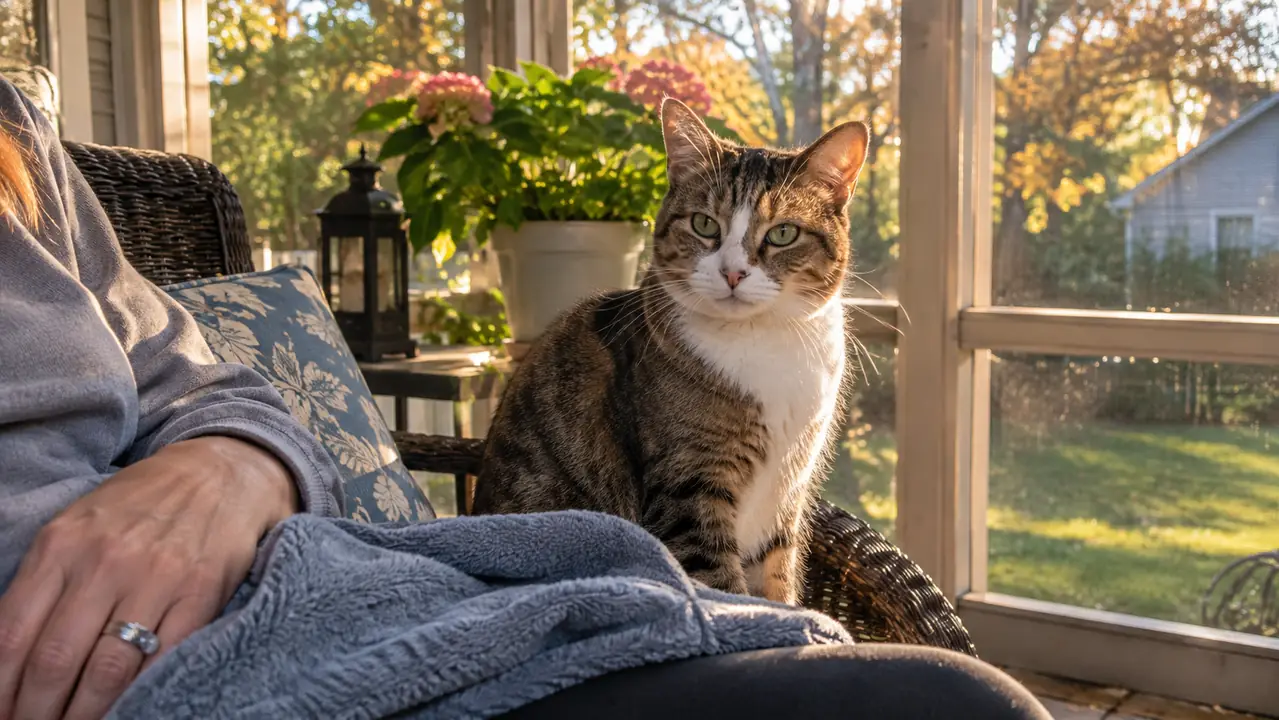
Junebug is the calico I adopted from the shelter in spring 2024, and by her first full summer she had shed a second cat's worth of hair onto my couch. I am Lorraine. I live in Hickory, North Carolina, I work the early shift at a gas station convenience store, and I have four indoor cats. I am not a groomer, I am not a vet tech, and I am not going to pretend otherwise. I am the person who does the vacuuming. In June 2025 I bought the FURminator deShedding tool for short-haired cats, medium to large, after one too many afternoons of pulling black fur off Gary's work shirts with my bare hand. Seventeen months later it still lives in the plastic bin in the laundry room, and it is the only thing I have bought that made a visible difference in how much hair ends up on the furniture.
Most shedding advice tells you to brush your cat more. That is not a plan, that is a chore with no instructions attached. What I actually needed to know was which tool, how often, how hard to press, and when to quit before my cat decided she had opinions about the whole enterprise. The five steps below are what I settled into. They are not complicated, they cost me about five to ten minutes an afternoon, and they work on a cat who tolerates being touched but does not love it. If your cat is long-haired, this particular tool is not the one for her, and I say that in the first step.
The tool that filled my porch with undercoat instead of my couch
The FURminator medium to large deShedding tool for short hair is the one I have used on Junebug since June 2025. It has a stainless steel edge, a curved profile that glides over the skin, and a handle that stays put in a wet hand. Check the sizing line before you order, because the listing is specific about it.
Amazon Check Today's Price on Amazon →Step 1: Get the size and the hair type right before you buy anything
The listing for this tool says one thing very plainly: choose the large size for cats over 10 pounds. That is the whole sizing rule, and it is worth reading twice, because the tool is sold in more than one configuration and the size you want depends on the cat, not on how much hair you are looking at. Junebug runs about 10 pounds, so she sits right on that line and the medium to large tool is what I use on her. Biscuit is an orange tabby who runs about 14 pounds, and the same tool works on him. If you have a small cat well under 10 pounds, the smaller size is the one the listing points you toward.
The other half of the label is hair type. This is the short hair tool. It is built for a coat that lies close to the body, which is what Junebug has. Two of my cats have coats like that and two do not, and I want to be honest that I only use this on the two who do. The listing describes a stainless steel deShedding edge that reaches through the topcoat to remove loose hair and undercoat, plus a curved edge designed to glide over the skin rather than dig in at the corners. The tool measures 2 by 5 by 8.75 inches and weighs 5.44 ounces, so it is small enough to hold in one hand for ten minutes without your wrist complaining.
Before this I used a slicker brush from the grocery store. I do not know the brand, it was whatever was on the shelf, and it is still in the bin. A slicker is fine for a light once-over, and I still use mine on Mabel, who is 15 and has a thin coat and older skin. But on Junebug the slicker mostly rearranged the hair that was already going to fall off anyway. The difference with a deShedding edge is that it goes after the loose undercoat that is sitting there ready to drop, not just the surface.
Step 2: Pick the same calm hour and the same calm spot every time
My shift starts at 5:00 in the morning, so I am home a little after 2:00 in the afternoon. That is when I brush. Not when I walk in the door, and not right after the wet food goes down, because Junebug is busy with more important business then. I wait until she has eaten and had her nap and has wandered out to the screened porch on her own. A cat who came to the porch by choice is a cat who will sit still for five minutes. A cat I carried out there is a cat who will be gone in ninety seconds.
The spot matters as much as the hour. For us it is the wicker chair on the screened porch, with an old towel over my lap. Same chair, same towel, same time of day. Cats are routine animals, and after a few weeks Junebug started showing up in that chair before I did. If you do not have a porch, a bathroom with the door shut works, because there is nowhere for the cat to go and nothing to bolt under. What you want is a small, boring, familiar space with no dog, no vacuum and no visitors.
Give her a minute before you touch her with anything. I set the tool down on the towel where she can see it and let her sniff the handle. That sounds like fussing, and maybe it is, but it is faster than starting with a hand coming at her from above. If your cat flinches away from the tool on the first sniff, put it down and try again tomorrow. There is no prize for winning the first round.
Step 3: Short, light strokes in the direction the hair already grows
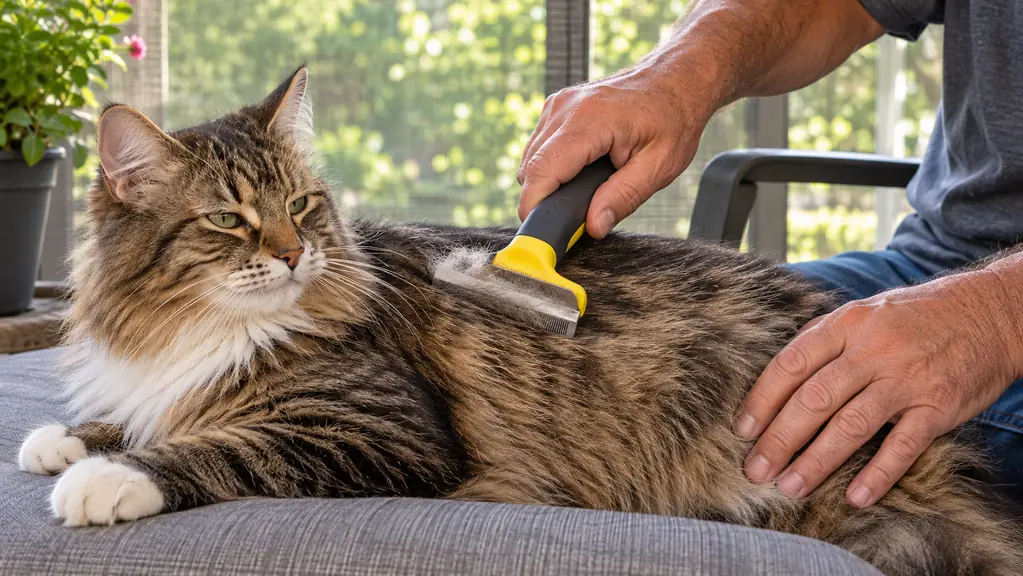
Start at the back of the neck and work toward the tail, in short overlapping strokes that follow the coat. Light pressure. The curved edge is meant to follow the shape of the cat rather than dig in, and it does, but only if you are not leaning on it. I go down the back, then each side, then the base of the tail, then the backs of the hind legs where the fur is thickest. I do not touch her belly, her face, her legs below the knee, or anywhere she flinches. Five to ten minutes total, and when the timer in my head goes off I stop whether or not I think there is more to get.
The first session was honestly startling. Far more loose hair came off in five minutes than the slicker had ever pulled in fifteen, and the hair came up in a soft mat along the edge instead of scattering into the air. That is the part I had not expected, that it releases the hair in a clump rather than throwing it around the room. I did what a lot of people probably do and kept going because it was satisfying. That was a mistake. Junebug walked off halfway through and did not come near me the next afternoon.
It is genuinely easy to overdo this tool. The listing calls it comfortable and easy grooming, and it is, for the cat who is used to it. But it removes a lot at once, and doing too much in one sitting is how you end up with a cat who hides when she sees the handle. Short sessions, two or three afternoons a week, is what I landed on. Biscuit, who is bigger and less fussy, gets one session a week, mostly because he does not need more than that and because he is food motivated enough to sit through anything if he thinks a treat is coming.
Step 4: Stop the second she tells you to stop
Cats do not usually bite first. They warn you. The skin along the back twitches. The tail starts flicking at the tip. The ears rotate back a quarter inch. There is a low sound in the chest that is not a purr. When I see the twitch, the session is over, and I say so out loud in a cheerful voice so it does not feel like a fight. Stopping at the twitch is the whole reason Junebug still lets me near her with the tool seventeen months later. Stop at the twitch, not at the swat.
I never use this on Mabel. She is my senior, 15 years old, about 8 pounds, and her coat has gotten thinner as she has aged. Dr. Patel has called her stiffness normal aging and told me to keep her comfortable, and that is all I am going to say about it because I am not qualified to say more. What I know from my own hands is that her skin feels different and the deShedding edge is too much for it. Mabel gets the old slicker, very lightly, for a minute at a time, and mostly she gets left alone.
One thing to watch for: if you see a bald patch, red or broken skin, or your cat suddenly will not let you touch a spot she used to tolerate, stop brushing and call your vet. That is true whether you use this tool or your fingers. A change in coat can be nothing, and it can be something that needs a professional look, and there is no way for me to tell you which from here. Same for any change in eating, drinking, litter box habits, weight, breathing or behavior. Call the vet.
Step 5: Keep the routine small and clean the edge after every session
Two or three afternoons a week is the schedule that has held for over a year. Not daily. Daily was what I tried first and it turned a calm cat into a suspicious one. The point is not to get every loose hair today, it is to still be doing this in six months. There is a rhythm to it too, because shedding comes in waves. Junebug is worst in early summer, when the coat she grew for winter lets go all at once, and a good deal lighter in January. I adjust to what I am seeing rather than to the calendar.
After every session I pull the loose hair out of the edge, rinse the metal under warm water, dry it on the towel and put it back in the plastic bin in the laundry room. It takes about thirty seconds and it keeps the edge working the way it did on day one. The handle is plastic and rubber per the listing, which means it does not slip when my hands are damp, and it also means I do not leave it sitting in water.
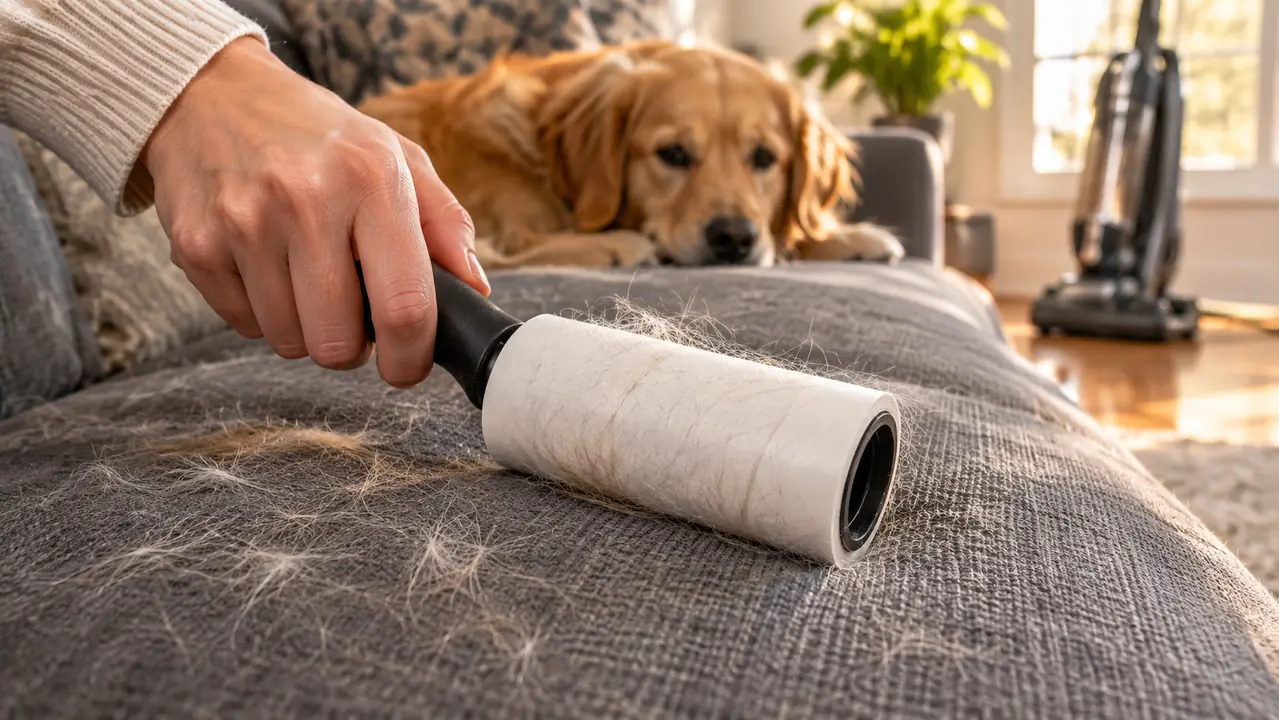
Then the rest of the house. I vacuum twice a week instead of once, which is the unglamorous half of this whole project. I keep a lint roller in the truck and one by the door for Gary's work shirts. I wash the cushion covers when I think of it. And I accept that Junebug still sheds, because she is a cat and cats shed. The FURminator removes loose hair that was already on its way off. It does not stop a cat from shedding and nobody should tell you it does.
What Else Helps
A damp washcloth helps more than you would think on the face and the ears, where the tool should never go. A rubber glove, the kind you wash dishes in, will pick up a surprising amount of surface hair if you wet it slightly and wipe the couch in one direction. Both of those are things I already had in the house. Neither one replaces a proper session with the deShedding edge, but they handle the ten minutes before company arrives.
If your cat is drinking less than you would like, or is carrying a little extra weight, or has gotten slower about the stairs, those are conversations for your vet and not for a grooming tool. I have had both of those conversations about my own cats. Pepper has always ignored a water bowl, and Dr. Patel suggested finding ways to get more water into her at her February 2025 checkup, which is a whole separate thing from hair. Biscuit was told at his October 2025 checkup to lose a bit of weight and keep moving. A brush does not touch either of those.
The last thing I would tell you is to be patient with the mess in between. There is a stretch of a few weeks where it looks worse, because you are pulling out the coat that was going to end up on the floor anyway and it is now on your lap instead. Then it settles down. My couch stopped wearing a layer of calico somewhere around August of that first summer, and it has stayed that way since. That is not a guarantee for your cat. It is just what happened in my living room.
Far more loose hair came off Junebug in five minutes than the grocery store slicker had ever pulled in fifteen, and it came up in a clump along the edge instead of scattering around the room.
Five minutes on the porch beats an hour with a lint roller
The FURminator medium to large deShedding tool for short hair has been in my laundry room bin since June 2025 and it is still the thing I reach for on brushing afternoons. If your cat is over 10 pounds and short-haired, that is the size the listing points you toward. Start with short sessions and stop early.
Amazon Check Today's Price on Amazon →